

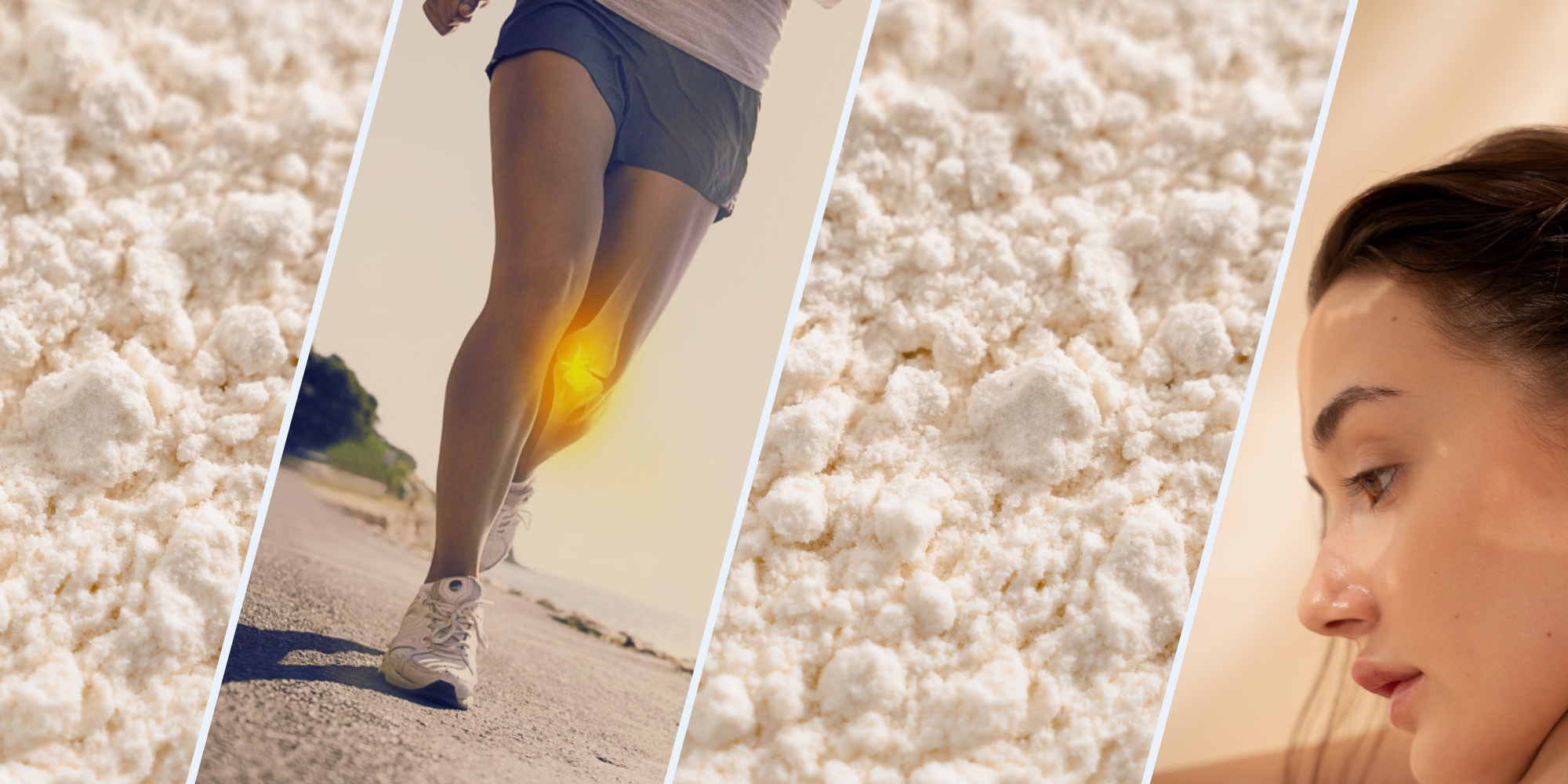

Collagen as the scaffold of cartilage
Collagen as the Cartilage Scaffold: Why Collagen Fibers are So Important for Healthy Joints Cartilage is a fascinating tissue: it is smooth, elastic, resilient, and allows joints to move with minimal friction. For cartilage to perform this function, it needs a stable internal structure. Collagen plays a central role in this. Collagen fibers form a three-dimensional network in cartilage. This network acts like a scaffold, giving cartilage its shape, stability, and tensile strength. At the same time, it ensures that important components like proteoglycans and water can be retained in the cartilage. This exact combination makes cartilage resistant to compressive loads. How is Cartilage Structured? Articular cartilage, for example, the hyaline cartilage in joints, does not consist solely of cells. A large part of the tissue is the so-called extracellular matrix. This matrix contains, among other things, collagen fibers, proteoglycans, and water. The most important components are: ChondrocytesThese are the cartilage cells. They reside in small cavities called lacunae and are responsible for maintaining the cartilage matrix. Collagen fibersThey form a stable fibrous network. In articular cartilage, collagen type II plays a central role. Proteoglycans and waterProteoglycans bind water, thereby providing pressure elasticity. They enable the cartilage to absorb loads. Subchondral boneBeneath the cartilage layer lies the bone. It forms the solid base of the joint. Collagen Type II: The Structural Protein of Cartilage Collagen is a structural protein. In cartilage, collagen type II is primarily found. This collagen forms fine fibrils and fibers that connect to form a stable network. One can imagine this network as a scaffold: it gives cartilage its shape and holds the other components of the matrix in place. Without this scaffold, the cartilage would be significantly less stable and less able to perform its function as a shock absorber. The construction takes place in several stages: Individual collagen molecules first form a triple helix. From these structures, microfibrils are formed, then collagen fibrils, and finally larger collagen fibers. These fibers form the stable basic framework of the cartilage. Why is the Collagen Scaffold So Important? The collagen network fulfills several crucial tasks. 1. Stability and Shape The collagen scaffold gives cartilage tensile strength. It ensures that the cartilage retains its shape and can withstand the mechanical forces in the joint. Especially during movement, strong stresses act on the cartilage: pressure, tension, shear forces, and impacts. The collagen network helps to distribute these forces and maintain the cartilage's structure. 2. Pressure Elasticity and Shock Absorption Cartilage must be able to absorb pressure. This property arises primarily from the interaction of collagen fibers, proteoglycans, and water. Proteoglycans bind water in the cartilage. Under load, water is partially displaced within the tissue; when the load is removed, it can be reabsorbed. However, this only works optimally if the collagen scaffold is intact and retains the water-binding components within the cartilage. This creates the typical pressure elasticity of cartilage: it can absorb loads and then return to its original shape. 3. Protection against the Loss of Important Matrix Components An intact collagen network prevents proteoglycans and water from being flushed out of the cartilage under load. This is crucial because proteoglycans are particularly important for the elasticity and shock absorption of cartilage. If the collagen scaffold is weakened or damaged, proteoglycans and water can be more easily lost. The cartilage then loses elasticity, resilience, and damping capacity. 4. Environment for Cartilage Cells Chondrocytes also benefit from a stable matrix. They are embedded in the collagen network and are in constant exchange with their surroundings. Only if this environment is intact can the cartilage cells optimally fulfill their tasks in the tissue. What Happens if the Collagen Scaffold is Damaged? If the collagen structure in the cartilage is disturbed, the balance of the cartilage matrix can be impaired. Proteoglycans and water can be retained less effectively, pressure elasticity decreases, and the mechanical resilience of the cartilage can diminish. In the long term, this can contribute to the cartilage becoming more susceptible to wear and tear. Especially in joints that are regularly subjected to heavy loads, a stable cartilage matrix is therefore particularly important. Collagen as the Basis for Healthy Joint Function Healthy joints need resilient cartilage. And resilient cartilage needs an intact collagen scaffold. Collagen fibers form the structural basis of cartilage. They stabilize the tissue, retain proteoglycans and water in the matrix, and contribute to the cartilage's ability to absorb compressive loads. Therefore, collagen is much more than just a building block: it is the basic framework that enables cartilage to function. Conclusion: No Resilient Cartilage Without a Collagen Scaffold Cartilage relies on a finely tuned interplay of various components. Collagen fibers, proteoglycans, water, and cartilage cells together form a functional unit. The collagen scaffold ensures that the cartilage remains stable, retains its shape, and can absorb loads. It prevents important matrix components from being washed out and creates the basis for elasticity and shock absorption. In short: collagen forms the supportive scaffold of cartilage — and is thus a central component of healthy, resilient joints.
Learn more
Bioactive Collagen Peptides for Suspensory Ligament Injury
How bioactive collagen peptides can support the healing of a suspensory ligament injury A suspensory ligament injury is one of the more common and at the same time protracted injuries to the musculoskeletal system of horses. Tendon and ligament structures, which are exposed to high stresses in everyday life and training, are particularly affected. Healing requires time, patience, and a well-coordinated rehabilitation concept. In addition to veterinary diagnostics, controlled exercise, and individually tailored training, targeted nutrient supply is also increasingly coming into focus. Bioactive collagen peptides offer a possible nutritional support. What happens in a suspensory ligament injury? The suspensory ligament, also known as the ligamentum suspensorium, stabilizes the fetlock area and stores elastic energy under load. It therefore plays a central role in the mobility, stability, and load-bearing capacity of the horse's leg. When an injury occurs, micro-injuries, tears, or structural changes occur in the tissue. The healing of such injuries is challenging because tendon and ligament tissue has a poorer blood supply compared to other types of tissue and regenerates slowly. Healing generally proceeds in several phases: 1. Inflammatory phaseIn the first few days after the injury, the body reacts with an inflammatory response. Damaged tissue is broken down, immune cells are activated, and the basis for subsequent repair is created. 2. Reparation phaseIn the following weeks, the body begins to build new collagen fibers. Initially, collagen type III often forms, serving as a kind of provisional repair tissue. However, this tissue is not yet fully load-bearing. 3. Remodeling phaseOver weeks to months, the newly formed tissue is rebuilt and organized. The goal is a more stable, load-bearing structure with a higher proportion of collagen type I. This phase is crucial for future load-bearing capacity. The problem: New tissue is often less resilient initially After an injury, newly formed tendon or ligament tissue is often less elastic and less organized than the original tissue. The collagen fibers first have to align themselves along the lines of stress and stabilize. This is precisely why too rapid a training build-up is risky. If the tissue is subjected to too much stress too early or too intensely, the risk of re-injury can increase. Well-thought-out rehabilitation is therefore indispensable. What are bioactive collagen peptides? Collagen is an important structural component of tendons, ligaments, cartilage, skin, and bones. Bioactive collagen peptides are formed when collagen is enzymatically broken down into smaller peptide chains. These peptides can be well absorbed by the body and contain important amino acids such as glycine, proline, and hydroxyproline. What is special: Bioactive collagen peptides do not only serve as a pure protein source. They can act as specific peptides in the body and support processes in the connective tissue. How can bioactive collagen peptides support healing? Bioactive collagen peptides can support the body during regeneration on several levels. 1. Support of collagen formation Fibroblasts play a central role in the repair of tendon and ligament tissue. These cells are responsible for the formation of new collagen fibers. Bioactive collagen peptides can act as signaling molecules and activate fibroblasts. This can support the body's own production of collagen - an important process when injured tissue needs to be rebuilt. 2. Improvement of fiber structure For resilient tendon and ligament tissue, not only the amount of collagen is crucial, but also its structure. Collagen fibers must be aligned as orderly as possible along the lines of stress. Better organization of collagen fibers can help the newly formed tissue to become more stable and functional in the long term. 3. Support of the extracellular matrix Tendons and ligaments consist not only of collagen fibers. The so-called extracellular matrix also plays an important role. It forms the environment in which the collagen fibers are embedded and contributes to the mechanical strength and elasticity of the tissue. Bioactive collagen peptides can support the formation of important matrix components and thus contribute to the quality of the repaired tissue. 4. Sensible combination with vitamin C Vitamin C is an important cofactor for collagen synthesis. It is required, among other things, for the cross-linking of collagen. This cross-linking helps to make collagen fibers more stable. Therefore, the combination of bioactive collagen peptides and vitamin C can be useful if the body is to be supported in building connective tissue. When is use appropriate? The use of bioactive collagen peptides can be particularly useful in the repair phase and during the subsequent remodeling. That is, exactly when the body forms new collagen and gradually rebuilds the tissue. However, it is important: A supplementary feed is not a substitute for veterinary treatment. In the case of a suspensory ligament injury, diagnosis, therapy plan, and rehabilitation should always be coordinated with the veterinarian. Bioactive collagen peptides can be a building block in the overall concept - together with controlled exercise, adapted shoeing, rest periods, regular checks, and a structured rehabilitation plan. Dosage and application The exact dosage should be based on the product, body weight, feeding situation, and veterinary recommendation. In practice, collagen peptides are often fed for several weeks to months, as the remodeling of tendon and ligament tissue is a long-term process. Continuous application over a sufficiently long period is crucial. Conclusion: Support for tissue quality and resilience A suspensory ligament injury requires time, patience, and consistent rehabilitation management. Bioactive collagen peptides can support the body during regeneration by positively accompanying collagen formation, the structure of the newly formed tissue, and the extracellular matrix. They can therefore contribute to better tissue quality and resilience - provided they are used as part of a holistic therapy and rehabilitation concept. Important: If a suspensory ligament injury is suspected or if lameness exists, veterinary clarification should always be sought. Supplementary feed can support, but does not replace diagnostics, treatment, or controlled rehabilitation.
Learn more
Bioactive Peptide Fractions
Bioactive peptide fractions are specific protein fragments that can have a positive impact on the body's condition and function, ultimately influencing health by modulating physiological processes [Gómez-Guillén et al 2011]. They usually consist of 2 to 20 amino acids per molecule. This corresponds to a molecular weight of approximately 0.2 to 6.2 kDa*. As long as they are integrated into the protein, they do not exhibit these properties, meaning they must first be released. This occurs either naturally in the gastrointestinal tract through digestion, bacterial fermentation, or through targeted production. Furthermore, they must be absorbed by the body and transported to the corresponding site of action.For example, it is known that milk or whey proteins contain peptides that can influence the physiological processes of the immune system, cardiovascular system, and nervous system. However, peptides derived from other foods are also the subject of intensive research, such as peptides obtained from collagen structures. Collagen is the most important structural protein in the body of vertebrates, making up 25 – 35% of the total protein content. Due to their widespread distribution, structural and biological properties, collagen peptides are biocompatible and safe [Fu et al 2018]. Since bioactive peptides are also formed through natural processes, humans have been accustomed to them since ancient times. Bioactive collagen peptides are attributed with blood pressure-lowering, antidiabetic, antioxidative, and health-promoting effects on bones, joints, and skin [Fu et al 2018]. Collagen peptides represent a promising area of research, but their potential still needs to be confirmed in clinical studies. On my website, I strive to keep the information up to date. At the end of each chapter, you will find the last update status. References can be found under Overview of Literature Sources. * kDa = Kilodalton, 1 kDa = 1,000 Daltons / atomic mass unit The following illustration shows the process of protein biosynthesis
Learn more