

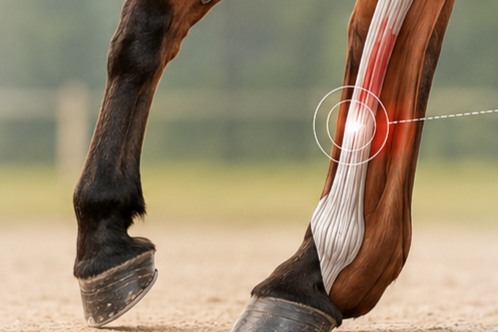
How bioactive collagen peptides can support the healing of a suspensory ligament injury
A suspensory ligament injury is one of the more common and at the same time protracted injuries to the musculoskeletal system of horses. Tendon and ligament structures, which are exposed to high stresses in everyday life and training, are particularly affected. Healing requires time, patience, and a well-coordinated rehabilitation concept.
In addition to veterinary diagnostics, controlled exercise, and individually tailored training, targeted nutrient supply is also increasingly coming into focus. Bioactive collagen peptides offer a possible nutritional support.
What happens in a suspensory ligament injury?
The suspensory ligament, also known as the ligamentum suspensorium, stabilizes the fetlock area and stores elastic energy under load. It therefore plays a central role in the mobility, stability, and load-bearing capacity of the horse's leg.
When an injury occurs, micro-injuries, tears, or structural changes occur in the tissue. The healing of such injuries is challenging because tendon and ligament tissue has a poorer blood supply compared to other types of tissue and regenerates slowly.
Healing generally proceeds in several phases:
1. Inflammatory phase
In the first few days after the injury, the body reacts with an inflammatory response. Damaged tissue is broken down, immune cells are activated, and the basis for subsequent repair is created.
2. Reparation phase
In the following weeks, the body begins to build new collagen fibers. Initially, collagen type III often forms, serving as a kind of provisional repair tissue. However, this tissue is not yet fully load-bearing.
3. Remodeling phase
Over weeks to months, the newly formed tissue is rebuilt and organized. The goal is a more stable, load-bearing structure with a higher proportion of collagen type I. This phase is crucial for future load-bearing capacity.
The problem: New tissue is often less resilient initially
After an injury, newly formed tendon or ligament tissue is often less elastic and less organized than the original tissue. The collagen fibers first have to align themselves along the lines of stress and stabilize.
This is precisely why too rapid a training build-up is risky. If the tissue is subjected to too much stress too early or too intensely, the risk of re-injury can increase. Well-thought-out rehabilitation is therefore indispensable.
What are bioactive collagen peptides?
Collagen is an important structural component of tendons, ligaments, cartilage, skin, and bones. Bioactive collagen peptides are formed when collagen is enzymatically broken down into smaller peptide chains. These peptides can be well absorbed by the body and contain important amino acids such as glycine, proline, and hydroxyproline.
What is special: Bioactive collagen peptides do not only serve as a pure protein source. They can act as specific peptides in the body and support processes in the connective tissue.
How can bioactive collagen peptides support healing?
Bioactive collagen peptides can support the body during regeneration on several levels.
1. Support of collagen formation
Fibroblasts play a central role in the repair of tendon and ligament tissue. These cells are responsible for the formation of new collagen fibers.
Bioactive collagen peptides can act as signaling molecules and activate fibroblasts. This can support the body's own production of collagen - an important process when injured tissue needs to be rebuilt.
2. Improvement of fiber structure
For resilient tendon and ligament tissue, not only the amount of collagen is crucial, but also its structure. Collagen fibers must be aligned as orderly as possible along the lines of stress.
Better organization of collagen fibers can help the newly formed tissue to become more stable and functional in the long term.
3. Support of the extracellular matrix
Tendons and ligaments consist not only of collagen fibers. The so-called extracellular matrix also plays an important role. It forms the environment in which the collagen fibers are embedded and contributes to the mechanical strength and elasticity of the tissue.
Bioactive collagen peptides can support the formation of important matrix components and thus contribute to the quality of the repaired tissue.
4. Sensible combination with vitamin C
Vitamin C is an important cofactor for collagen synthesis. It is required, among other things, for the cross-linking of collagen. This cross-linking helps to make collagen fibers more stable.
Therefore, the combination of bioactive collagen peptides and vitamin C can be useful if the body is to be supported in building connective tissue.
When is use appropriate?
The use of bioactive collagen peptides can be particularly useful in the repair phase and during the subsequent remodeling. That is, exactly when the body forms new collagen and gradually rebuilds the tissue.
However, it is important: A supplementary feed is not a substitute for veterinary treatment. In the case of a suspensory ligament injury, diagnosis, therapy plan, and rehabilitation should always be coordinated with the veterinarian.
Bioactive collagen peptides can be a building block in the overall concept - together with controlled exercise, adapted shoeing, rest periods, regular checks, and a structured rehabilitation plan.
Dosage and application
The exact dosage should be based on the product, body weight, feeding situation, and veterinary recommendation.
In practice, collagen peptides are often fed for several weeks to months, as the remodeling of tendon and ligament tissue is a long-term process. Continuous application over a sufficiently long period is crucial.
Conclusion: Support for tissue quality and resilience
A suspensory ligament injury requires time, patience, and consistent rehabilitation management. Bioactive collagen peptides can support the body during regeneration by positively accompanying collagen formation, the structure of the newly formed tissue, and the extracellular matrix.
They can therefore contribute to better tissue quality and resilience - provided they are used as part of a holistic therapy and rehabilitation concept.
Important: If a suspensory ligament injury is suspected or if lameness exists, veterinary clarification should always be sought. Supplementary feed can support, but does not replace diagnostics, treatment, or controlled rehabilitation.

