

Collagen as the Cartilage Scaffold: Why Collagen Fibers are So Important for Healthy Joints
Cartilage is a fascinating tissue: it is smooth, elastic, resilient, and allows joints to move with minimal friction. For cartilage to perform this function, it needs a stable internal structure. Collagen plays a central role in this.
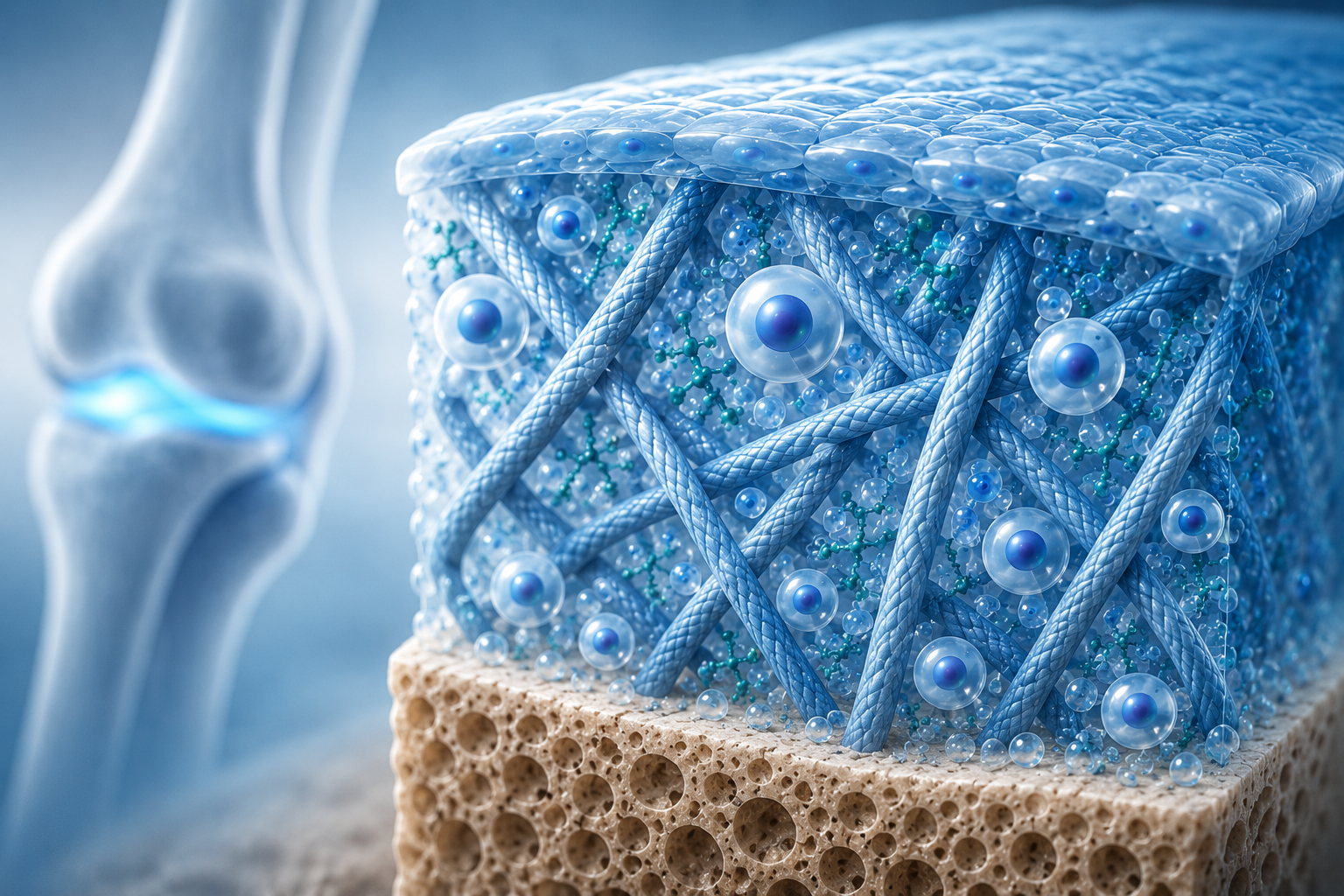
Collagen fibers form a three-dimensional network in cartilage. This network acts like a scaffold, giving cartilage its shape, stability, and tensile strength. At the same time, it ensures that important components like proteoglycans and water can be retained in the cartilage. This exact combination makes cartilage resistant to compressive loads.
How is Cartilage Structured?
Articular cartilage, for example, the hyaline cartilage in joints, does not consist solely of cells. A large part of the tissue is the so-called extracellular matrix. This matrix contains, among other things, collagen fibers, proteoglycans, and water.
The most important components are:
Chondrocytes
These are the cartilage cells. They reside in small cavities called lacunae and are responsible for maintaining the cartilage matrix.
Collagen fibers
They form a stable fibrous network. In articular cartilage, collagen type II plays a central role.
Proteoglycans and water
Proteoglycans bind water, thereby providing pressure elasticity. They enable the cartilage to absorb loads.
Subchondral bone
Beneath the cartilage layer lies the bone. It forms the solid base of the joint.
Collagen Type II: The Structural Protein of Cartilage
Collagen is a structural protein. In cartilage, collagen type II is primarily found. This collagen forms fine fibrils and fibers that connect to form a stable network.
One can imagine this network as a scaffold: it gives cartilage its shape and holds the other components of the matrix in place. Without this scaffold, the cartilage would be significantly less stable and less able to perform its function as a shock absorber.
The construction takes place in several stages: Individual collagen molecules first form a triple helix. From these structures, microfibrils are formed, then collagen fibrils, and finally larger collagen fibers. These fibers form the stable basic framework of the cartilage.
Why is the Collagen Scaffold So Important?
The collagen network fulfills several crucial tasks.
1. Stability and Shape
The collagen scaffold gives cartilage tensile strength. It ensures that the cartilage retains its shape and can withstand the mechanical forces in the joint.
Especially during movement, strong stresses act on the cartilage: pressure, tension, shear forces, and impacts. The collagen network helps to distribute these forces and maintain the cartilage's structure.
2. Pressure Elasticity and Shock Absorption
Cartilage must be able to absorb pressure. This property arises primarily from the interaction of collagen fibers, proteoglycans, and water.
Proteoglycans bind water in the cartilage. Under load, water is partially displaced within the tissue; when the load is removed, it can be reabsorbed. However, this only works optimally if the collagen scaffold is intact and retains the water-binding components within the cartilage.
This creates the typical pressure elasticity of cartilage: it can absorb loads and then return to its original shape.
3. Protection against the Loss of Important Matrix Components
An intact collagen network prevents proteoglycans and water from being flushed out of the cartilage under load. This is crucial because proteoglycans are particularly important for the elasticity and shock absorption of cartilage.
If the collagen scaffold is weakened or damaged, proteoglycans and water can be more easily lost. The cartilage then loses elasticity, resilience, and damping capacity.
4. Environment for Cartilage Cells
Chondrocytes also benefit from a stable matrix. They are embedded in the collagen network and are in constant exchange with their surroundings. Only if this environment is intact can the cartilage cells optimally fulfill their tasks in the tissue.
What Happens if the Collagen Scaffold is Damaged?
If the collagen structure in the cartilage is disturbed, the balance of the cartilage matrix can be impaired. Proteoglycans and water can be retained less effectively, pressure elasticity decreases, and the mechanical resilience of the cartilage can diminish.
In the long term, this can contribute to the cartilage becoming more susceptible to wear and tear. Especially in joints that are regularly subjected to heavy loads, a stable cartilage matrix is therefore particularly important.
Collagen as the Basis for Healthy Joint Function
Healthy joints need resilient cartilage. And resilient cartilage needs an intact collagen scaffold.
Collagen fibers form the structural basis of cartilage. They stabilize the tissue, retain proteoglycans and water in the matrix, and contribute to the cartilage's ability to absorb compressive loads.
Therefore, collagen is much more than just a building block: it is the basic framework that enables cartilage to function.
Conclusion: No Resilient Cartilage Without a Collagen Scaffold
Cartilage relies on a finely tuned interplay of various components. Collagen fibers, proteoglycans, water, and cartilage cells together form a functional unit.
The collagen scaffold ensures that the cartilage remains stable, retains its shape, and can absorb loads. It prevents important matrix components from being washed out and creates the basis for elasticity and shock absorption.
In short: collagen forms the supportive scaffold of cartilage — and is thus a central component of healthy, resilient joints.

